Rabadash marches on Archenland
The Horse and His BoyRabadash’s march on Archenland is a covert invasion designed to turn the seizure of Anvard into a lasting military foothold against Narnia, while also giving Rabadash a chance to capture Queen Susan. Conceived as a swift raid that the Tisroc could disavow, it depends on surprise, the desert route, and limited bloodshed in Narnia; its exposure and defeat at Anvard reveal the gap between Rabadash’s carefully stated plan and the consequences of launching it.
Causes and Strategic Design
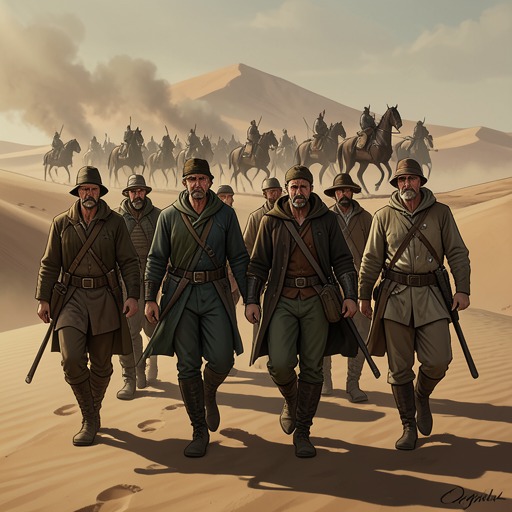
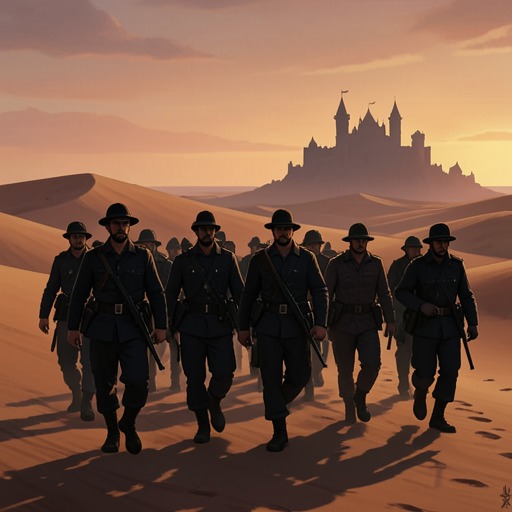
Rabadash proposes the expedition during a council with the Tisroc and Ahoshta Tarkaan. He offers a way to reach for Narnia while allowing his father to disclaim responsibility if the venture goes badly. His immediate target is Anvard, the castle of King Lune in Archenland: he intends to cross the desert with two hundred horsemen, arrive before the defenders are prepared, and take the castle. From there he plans to ride through the pass above Anvard and across Narnia to Cair Paravel, where he expects to find the High King absent.
The scheme joins territorial ambition to Rabadash’s pursuit of Queen Susan. He expects to wait at Cair Paravel for the arrival of the Splendor Hyaline, seize Susan when she comes ashore, and ride back to Anvard. Rabadash presents this as a fast operation with little Narnian bloodshed, but the capture of the castle is not merely a passage for his riders: he expects to keep Anvard permanently. A garrison there, increased gradually, would place Calormen at what he calls the gate of Narnia and prepare the way for a larger conquest.
The route matters because the obvious passage across the desert is not a viable way to move a large army. Sallowpad explains that the Great Oasis cannot supply enough water for all the soldiers and animals of a great force. A different route begins at the Tombs of the Ancient Kings, runs northwest with the double peak of Mount Pire ahead, and leads into a narrow, difficult-to-find valley; a river at its end provides a way into Archenland. This terrain knowledge supplies the logistical premise for the invasion, even as the desert’s distances and water scarcity make the march hazardous.
Authorization and Exposure
The Tisroc permits Rabadash to go but refuses to promise assistance or rescue. He warns that Rabadash will receive no help if he is killed or imprisoned, and makes his continued favor conditional on restraint: if Rabadash sheds more Narnian noble blood than necessary and provokes open war, his younger brother will take his place. The permission is thus also a calculated disclaimer. Rabadash accepts the terms and leaves to begin the expedition, while Ahoshta endorses the likelihood that Anvard’s fall would give Calormen control over Narnia’s approach.
The plan does not remain secret. Aravis overhears the council in the palace, including Rabadash’s proposed route, the intended capture of Susan, and the Tisroc’s refusal to take responsibility. This knowledge turns the march into a race: those who escape must cross the desert and reach Anvard before the force they have learned is coming. The invasion’s element of surprise is therefore compromised before its decisive assault, though Rabadash’s cavalry still makes rapid progress toward the castle.
The March and Threat at Anvard
The fugitives’ crossing shows the cost of the same desert that Rabadash intends to traverse. At a small outcrop of rock, they take brief shelter in its limited shade, eat, and drink sparingly. The horses manage the water from a skin bottle, but there is not enough for anyone; after a short rest they continue, searching for the concealed valley. The episode makes the military value of Sallowpad’s route concrete: water and navigation are constraints on movement, not incidental details.
The threat becomes visible when Aravis identifies an approaching force as Rabadash’s army. Hwin and Bree immediately turn north toward Anvard, recognizing that they must get there ahead of it. Later, at a fork in the road, Shasta hears cavalry approaching and fears that Rabadash will take whichever road he chooses. He leads his horse down the right-hand road and waits as the mounted column reaches the crossroads. Rabadash’s men take the other route, allowing Shasta to hear the commander’s orders and continue toward the castle with warning of the attack.
Rabadash’s instructions expose the limits of his earlier promise of restraint. In Archenland, he demands speed above all and orders his men to kill the castle’s male defenders, including children, while reserving women and valuables as spoils for his soldiers. He threatens to burn alive any rider who hangs back. His policy is divided by territory: in Narnia, he says, the soldiers are to kill as little as possible, treating Narnian blood as especially valuable for this venture; in Archenland, the assault is to be carried out without such restraint. The distinction is tactical rather than humane, and the rewards and threats are used to drive the attack forward.
Siege and Defeat
At Anvard, about fifty Calormenes are dismounted and using a tree trunk as a battering ram against the shut gate and lowered portcullis. The main body of Rabadash’s force is also on foot, ready to assault the entrance. When the Narnians arrive over a ridge, the attackers rapidly remount and turn to meet them. The scene changes from an assault on the castle to a battle between the besiegers and the relieving force.
The castle’s defenders join the fight when the gates open for a sortie led by King Lune, with his men beside him. The Great Cats attack the attackers and the men operating the ram; the ram is brought down, while the sortie and the returning Narnian force press the Calormenes from different sides. King Edmund fights in the battle, and the Calormene line is driven back. Some attackers flee and others surrender; Rabadash’s force is ultimately defeated. The castle gates stand open afterward, and King Lune and King Edmund meet across the fallen battering ram.
Consequences and Significance
Rabadash’s campaign fails at the first indispensable stage: he does not secure Anvard, and so cannot use it as the permanent base from which to extend Calormen’s reach into Narnia. The planned route to Cair Paravel and the intended capture of Susan depend on that initial success; once the attack is met by a relieving force and the Calormenes are defeated, those objectives are not achieved in this episode.
The march also exposes the contradiction between Rabadash’s language of prudence and the conduct he orders. Before his father, he presents a deniable expedition with limited Narnian losses; on the road to Anvard, he commands the killing of the castle’s male inhabitants and promises the rest as booty. His careful contingency plan cannot control the political or military consequences of violence: the Tisroc has already warned that excess bloodshed could bring open war and cost Rabadash his standing, while the defenders’ resistance prevents the quick capture on which the larger design rests.